


Almaty Region, Kazakhstan's fourth most populous region, shares a border with China, giving it a special role in Kazakhstan-China cooperation.
ALMATY, June 4 (Xinhua) -- "As a region bordering China and possessing transit corridor advantages, Almaty Region attaches great importance to its role in bilateral cooperation and is actively promoting the establishment of a local cooperation center," Marat Sultangaziev, governor of Kazakhstan's Almaty Region, said in a recent interview with Xinhua.
Almaty Region, Kazakhstan's fourth most populous region, shares a border with China, giving it a special role in Kazakhstan-China cooperation, Sultangaziev said in Konaev, the administrative center of Almaty Region in southeastern Kazakhstan.
Under the guidance of the two heads of state, Kazakhstan-China relations have entered a new "golden 30 years" of cooperation, creating favorable conditions for Almaty Region to position itself as a hub for cooperation with China, he said.
According to Sultangaziev, both economic cooperation and people-to-people exchanges with China have shown strong momentum. Trade turnover between Almaty Region and China has consistently exceeded 1 billion U.S. dollars in recent years, reaching 1.2 billion U.S. dollars in 2025, with further growth expected this year.
More than 40 investment projects are currently under discussion, which are expected to inject new momentum into bilateral economic and trade ties.
Sultangaziev said Almaty Region has signed cooperation and friendship memorandums with eight provincial-level regions in China, establishing stable cooperation mechanisms in manufacturing, agriculture and logistics.
He noted that the region's diversified economy is well-suited to cooperation with China. Deep processing of agricultural products, a traditional strength, has already yielded several operational projects and stable industrial partnerships.
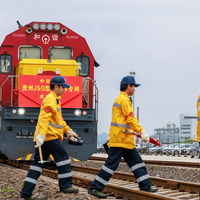
In logistics, the Korzhat border crossing, linked to China's Dulata port in Xinjiang, recently completed an expansion that nearly tripled its capacity. The region's railway and highway networks connect multiple border crossings, allowing transit cargo to reach destinations across Kazakhstan, Central Asia and Europe.
Almaty Region is also working to become a regional logistics hub, with upgraded warehousing and transit facilities capable of providing labeling, sorting, transshipment and storage services for Chinese cargo, he added.
Sultangaziev said Almaty Region ranks third nationwide in foreign tourist arrivals, after Almaty city and Astana. Since Kazakhstan and China introduced a mutual visa-free policy, the number of Chinese tourists to the region has increased significantly. To deepen cultural and people-to-people exchanges, local authorities are promoting tourism resources and organizing delegations to visit China.
He also highlighted the development of Alatau city, a newly established urban center in Almaty Region that is expected to host Kazakhstan's largest special economic zone.
After studying special economic zones worldwide, Kazakhstan identified Shenzhen -- a major economic hub in southern China -- as one of the most successful examples, he said. As a result, the two sides have carried out extensive cooperation in the planning and design of Alatau city, while maintaining close contacts between their administrative bodies.
Not long ago, a Chinese company conducted the first autonomous taxi test in the city, he noted, adding that Almaty Region welcomes more Chinese enterprises to participate in local projects and investment.